The energy sector uses a massive variety of terms and acronyms. Often, even people working daily in the industry understand these completely differently. We at Soleron decided to put together a short explanatory text to help clarify the actual meaning of these words. Here is a simple and comprehensive dictionary for you that makes complex concepts clear. For better readability, we have divided the keywords by main areas.
For solar system owners
- PV: This acronym stands for Photovoltaics. It is the technology that converts sunlight directly into electricity using solar panels.
- PV cannibalism: An economic phenomenon where high energy generation during sunny hours drives the wholesale electricity price down and reduces the revenue of all solar energy producers.
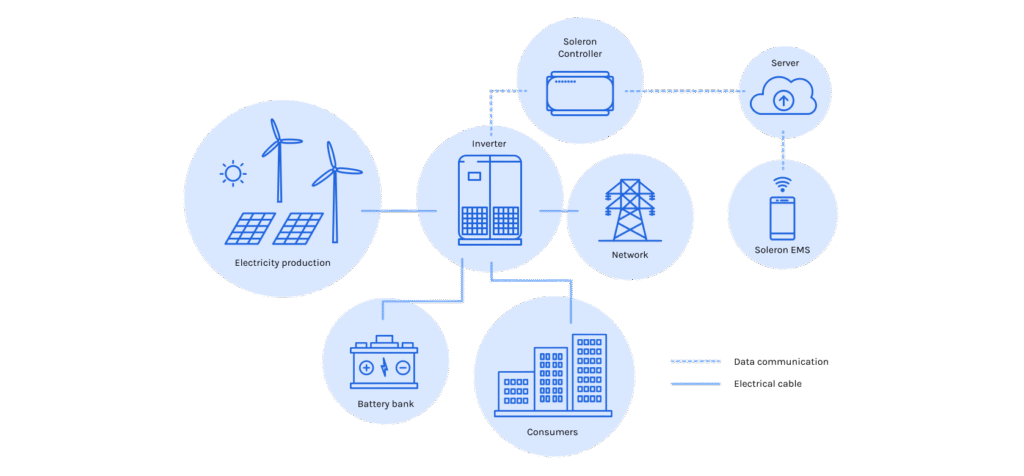
- Inverter: A device that converts direct current produced by solar panels or batteries into alternating current that can be used in the power grid.
- Net billing: A billing system where solar power plant owners are paid for excess electricity sent to the grid based on the wholesale price.
- BTM or Behind The Meter: Energy generation or storage systems located on the consumer side or inside the electricity meter.
- FTM or Front of the Meter: Large-scale power generation or storage systems located on the grid side or outside the electricity meter.
- Smart meter: An advanced energy meter that records consumption in real time and communicates the information back to the utility company.
- Self consumption: The amount of locally generated electricity that is used directly on site rather than being sent to the grid.
- Off-grid: A system that is completely disconnected from the traditional electrical network.
- Feed-in Tariff: A policy mechanism designed to accelerate investment in renewable energy technologies by offering long-term contracts to renewable energy producers.
- V2G or Vehicle to Grid: Technology that allows electric vehicles to return stored energy back to the power grid.
For battery storage owners
- BESS or Battery Energy Storage System: A system that stores energy from the power grid or renewable sources in batteries for later use.
- SoC or State of Charge: The current charge level of a battery expressed as a percentage of its maximum capacity.
- SoH or State of Health: An indicator that reflects the overall healthy condition of a battery compared to its original or ideal state.
- DoD or Depth of Discharge: The percentage of battery capacity that has been used compared to its total capacity.
- Ramp rate: The speed at which a power producer or battery system can increase or decrease its output power.
- Peak shaving: Using stored energy or reducing consumption during peak demand to save on electricity costs.
Power grid and market services
- Grid congestion: A situation where the transmission grid cannot safely handle all the electricity that needs to flow through it.
- FCR or Frequency Containment Reserve: The first and fastest response service used to stabilize the power grid frequency within seconds after a disturbance.
- aFRR or Automatic Frequency Restoration Reserve: An automatic balancing service that restores the grid frequency to standard levels after unexpected changes.
- mFRR or Manual Frequency Restoration Reserve: A manually activated balancing service that replaces faster reserve services and helps manage longer-lasting grid imbalances.
- BRP or Balance Responsible Party: A market participant responsible for ensuring that their planned energy production or consumption matches the actual physical energy use.
- Spot market: A public financial market where electricity is bought and sold for immediate delivery.
- Day-ahead market: The market where electricity is traded one day before delivery.
- Intraday market: The continuous market for trading electricity on the same day as delivery.
- Capacity market: A market mechanism that pays power plants or storage units a fee for being ready to produce electricity when needed.
- Time of Use pricing: Electricity prices that change according to the time of day and encourage consumers to use energy when it is cheaper and more available.
Management, investment and development
- VPP or Virtual Power Plant: A cloud-based network that connects decentralized production units, flexible consumers, and storage systems into a single virtual power plant.
- EMS or Energy Management System: Software and hardware solutions used to monitor, control, and optimize energy production and storage devices.
- SCADA or Supervisory Control and Data Acquisition: A control system architecture used for high-level monitoring and management of industrial processes and power plants.
- Microgrid: A small local energy system that can operate independently or together with the main power grid.
- Islanding: A situation where a local energy system can supply a location with electricity even when the main power grid goes down.
- EPC or Engineering Procurement and Construction: A contract type where a company takes full responsibility for designing, procuring materials, and building an energy project.
- PPA or Power Purchase Agreement: A long-term contract between an energy producer and a buyer to purchase electricity at a fixed price.
- CfD or Contract for Difference: A financial agreement that stabilizes revenues for energy producers by guaranteeing a fixed strike price.
- ROI and IRR: Return on Investment and Internal Rate of Return are critical metrics for evaluating the profitability of energy assets.
- GO or Guarantee of Origin: A certificate proving that a specific amount of electricity was produced from renewable sources.
General concepts and technical terms
- AC or Alternating Current: An electric current that periodically changes direction, which is the standard in power grids and homes.
- DC or Direct Current: An electric current flowing in one direction, produced by solar panels and stored in batteries.
- CapEx or Capital Expenditure: The initial capital costs required to build a new energy asset like a solar park or battery system.
- OpEx or Operational Expenditure: The ongoing costs associated with the daily management and maintenance of an energy asset throughout its lifespan.
- LCOE or Levelized Cost of Energy: A metric used to compare the total costs of electricity generated from different sources over their lifetime.
- Curtailment: The deliberate reduction of power output from renewable energy producers to keep supply and demand in balance or relieve grid overload.
- Grid parity: The point where the price of electricity produced from renewable energy sources is equal to or lower than the price of electricity bought from the traditional grid.
- Metering point: A specific physical location where electricity consumption or production is measured for billing and monitoring purposes.
- Wind turbine: A device that converts the kinetic energy of wind into electrical energy.
- Reactive power: The portion of electricity that sustains the electromagnetic field of alternating current equipment but does not perform useful work.
- Inertia: The kinetic energy stored in heavy spinning generators that helps maintain grid frequency during sudden disturbances.
- Black start: The process of restoring a power station to operation without relying on the external electric power transmission network.
- Baseload: The minimum level of demand on an electrical grid over a specific period.
- ROCOF or Rate of Change of Frequency: A metric that measures how quickly the grid frequency changes after a major disturbance.
Conclusion
We hope this short guide helps you navigate the rapidly evolving energy sector with greater confidence. At Soleron, our goal is to make complex energy concepts accessible to everyone. Whether you are looking to invest in a solar project, integrate battery storage, or simply want to understand the market better, knowing the right terminology is the perfect starting point. If there are any other terms you would like us to explain or if you need expert advice on your next energy project, the Soleron team is always here to help.